

If you’re not sure what TEUI3 is, Take me to the Index of Articles!
TEUI3 provides 15 different preset Reference Standards, 2 are from SB12 of the OBC prescriptive path tables, one is from SB10, 6 more are from NBC/NECB, one is from Canada Green Building Council (CaGBC) and the rest are from PHI or Passive House International. These are intended to demonstrate how the application of a reference standard at the cell for S.1. Reference Standard draws on some key metrics from each of those standards, and provides a pass/fail guidance value in column ‘M’.
One example is envelope guidance from a NECB Prescriptive pathway. The user-defined RSI values for the building below are using NECB values for Zone 6, Tier 1. The Reference column at the far right shows whether these comply with the selected standard. A pass gets a green checkmark, a fail gets a red X. The percentage above or below the reference value is also provided.

The user is expected to review the values in the ‘Reference Values’ worksheet, and if the given values for the relevant Zone, Tier or Code are not present, then a user can simply ‘copy’ an entire column between columns C and Q (to preserve all XLOOKUP functions in Excel), and ‘Paste Copied Cells’ into a newly created column. The user can then modify the relevant values from the specified standard, and the new Reference Standard will magically appear in the S.1 Reference Standard drop-down on the FACTS worksheet.
The user is expected to take full responsibility for the accuracy of the values even if they appear as presets in TEUI3, because reference standards change with almost every cycle of building code changes and may be different for different scenarios. For example, the prescriptive insulation values under NBC 9.36 are stricter for buildings that do not have ERV/HRV equipment specified, or they may vary as a function of the climate zone the building is in.
Another complication is that a user may wish to conform to a PHI standard such as PH Classic, but must also submit documentation demonstrating OBC compliance. Since PHI/PHPP and PH Classic do not specify RSI values for roofs, walls or slabs, but OBC does, then a user can select the relevant OBC reference standard to review the code compliance pathway, but then also toggle the PH Classic reference standard to confirm that BOTH standards criteria are met. And since OBC does not consider PER, or TEDI, or ACH50 the way that PHPP does, then by selecting ‘PH Classic’ from the S.1 Reference Standard, one can review whether these Key Performance Indicators are also met. This gives TEUI3 the flexibility to review multiple compliance pathways, as it is itself standards agnostic. The presets in TEUI3 however consider NBC, NECB and OBC compliance as the baseline, which must be met irrespective of any additional criteria defined by other standards.
One example is aggregate building airtightness values. PHI defines an ACH50 value of 0.6 as a pass/fail metric. However NBC 2020 defines Airtightness using the newer, arguably more relevant and accurate NLR50 metric per table [NBC Table 9.36.6.4.-A.], which can convert to an ACH50 number (TEUI3 shows both and does the calculation for you). Anything above AL-3A in this table is in fact more stringent than the PH Classic value of 0.6ACH@50 Pascals, so it is important to consider both reference methodologies, one for the Reference Standard of NBC compliance, and the other for PHI compliance/certification!
Since the NBC defines energy modelling schedules and loads for plug, light and equipment loads, this methodology applies as the default. This may have the effect of lowering the TEDI of a TEUI3 model, since the resulting internal gains may be higher, but then so too will the TEUI, as the result of more total energy use.
We have tried to make TEUI3 as simple as possible and easy to use, and as a result of this we have rounded some corners for a fast overview of a wide range of reference standards. For example, we do not provide an hourly dynamic breakdown of hot water use as defined in NBC 9.36 schedules, but have rather simplified this as a water-use parameter (275 l/pp-day) with a specific hot water impact, (~3.585 Watts/litre or approx. 360kWh/yr/pp). We also do not model solar gains on windows through every hour of the year, but have provided a bulk, averaged annual value across 8 cardinal orientations (50kWh/m2/yr), that comes from dynamic hourly modelling and PHPP bench tests.
Because of this, TEUI3 derived results will not match dynamic hourly modellers, or BIN/Monthly modellers, or PHPP. It is a simplified, static modelling tool, but it is a static modelling tool that has been designed to provide values as close as possible to real-world TEUI values from Actual utility bills of a range of test buildings, that have been used to refine and lock down the presets within the framework of OBC, NBC, and NECB defined values.
S.2 Actual (Bills) or Targeted (Design) Use
TEUI3 can be used to validate building energy and carbon performance, and this can be indicated by selecting the ‘Utility Bills’ option from the S.2 cell. However if Utility Bills are not yet available or the project is in Schematic or Early Stage Design, then the ‘Targeted Use’ option can be selected. This both serves to indicate to the reader of the TEUI3 printout, such as a Building Official or Engineering Subconsultant, that the TEUI3 is projecting an Energy Use Target based on the input parameters rather than evaluating a building post-occupancy from its utility bills. The ‘cost’ functions in Column O of the tool then toggle from costs inferred from energy bills and instead apply energy costs as a function of the Targeted Use. The terms ‘Actual’ and ‘Targeted’ correlate to Utility Bills and Targeted Use respectively. When the Targeted Use toggle is selected, ALL subsequent user inputs are projections of use, such as Renewable PV energy contribution or SHW/DHW use. When Utility Bills is selected, similarly all subsequent user inputs should reflect ‘As Built’ data, such as actual Renewable PV energy contributions from the metering system, or actual water usage from the water meters.
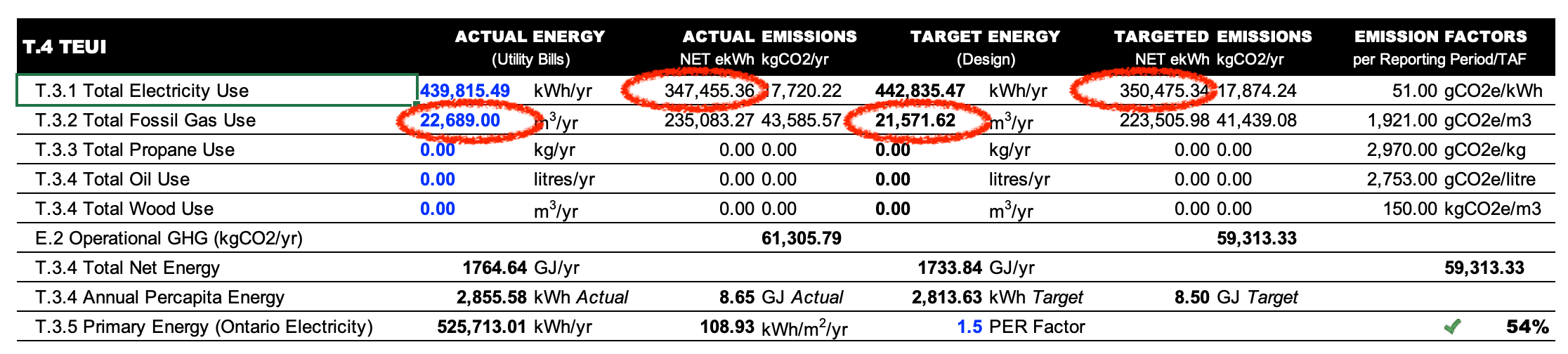
It is incredibly useful to review the TEUI3 Targeted Use data alongside real-world utility-bill-derived data in order to both troubleshoot the distribution of energy and carbon impacts in a building, but also to determine how to improve similar designs on future buildings. Values can be compared at the T.4 TEUI section near the top of the TEUI FACTS Worksheet. In the example below, TEUI3 projects a target gas use of 21,571.62m3/yr, whereas the actual measured value from the meter is 22,689m3/yr. Net electricity (minus renewables contribution) can likewise be compared, and the carbon emissions from real and target scenarios can be compared.
A third Standards section, S.3 Carbon Benchmarking Standard will be handled in another post, as it deals more with the upfront carbon or embodied carbon of the building, and must be calculated with tools external to TEUI3, even though TEUI3 will provide some guidance values for design from both the Toronto Green Standard as well as the CaGBC’s Zero Carbon Building Standard v4.0.
Leave a Reply